

When you walk into a casino, you need proper identification to enter and gamble. Casinos accept government-issued photo IDs like state driver’s licenses, state ID cards, passports, and military IDs as valid forms of identification. Your ID must be current, unexpired, and in good physical condition to be accepted.
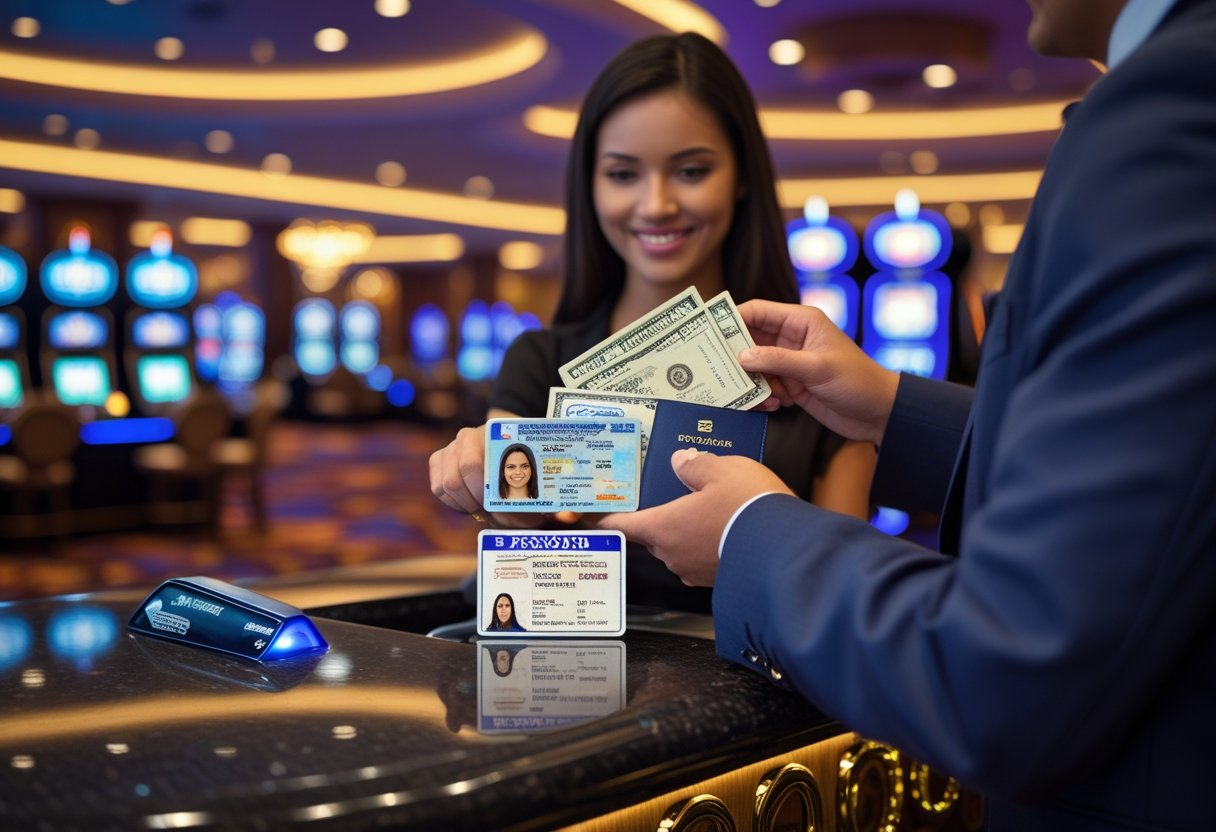
Knowing what to bring saves you time and prevents you from being turned away at the door. Casinos check IDs to verify you meet the legal gambling age and to follow federal regulations. Paper or temporary IDs usually won’t work because they lack proper security features.
This guide covers everything you need to know about casino identification requirements. You’ll learn which IDs work best, what to do in special situations, and how online casinos handle verification. Whether you’re planning your first visit or just want to be prepared, understanding these rules helps you avoid problems and enjoy your experience.
Casino ID Requirements and Age Restrictions
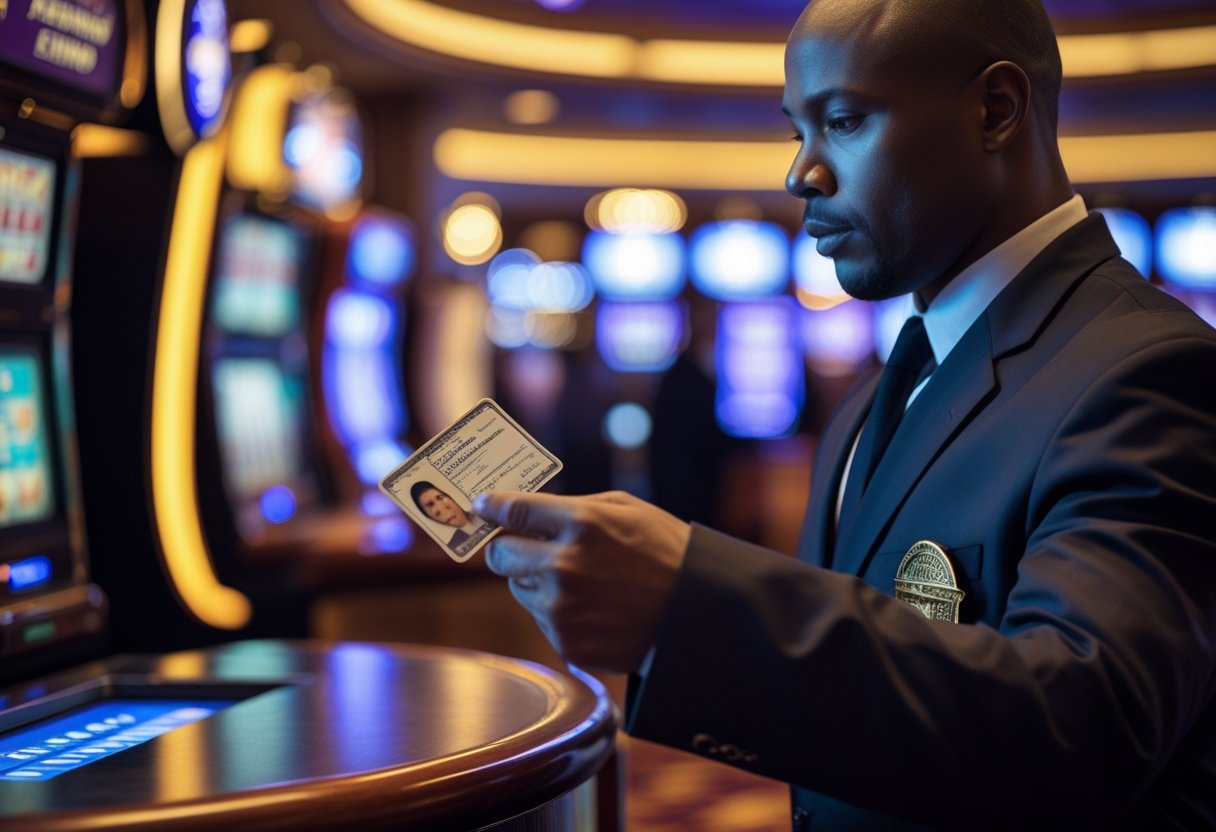
Casinos enforce strict identification checks to verify age and prevent underage gambling. You must meet specific age requirements and present valid identification to enter gaming areas.
Minimum Age to Enter and Gamble
You must be 21 years of age or older to enter and gamble at most casinos in the United States. This is the standard requirement across the majority of gaming establishments, though some jurisdictions allow gambling at 18.
Casinos typically card anyone who appears to be 30 or under. Some properties check identification for all guests regardless of appearance. You cannot bypass these checks even if you only plan to walk through the casino floor.
If you are under 21, you may be allowed to pass through casino areas to reach restaurants or hotels in some properties. However, you cannot stop to gamble or loiter near gaming machines or tables. Persons under 21 must be accompanied by someone over 21 to dine at casino restaurants in many establishments.
Why ID Verification Is Required
Casinos verify your identity to prevent underage gambling and comply with regulatory requirements. Gaming establishments face severe penalties, including license suspension or revocation, if they allow minors to gamble on their premises.
ID checks also serve security purposes beyond age verification. Casinos use identification to track self-excluded individuals who have voluntarily banned themselves from gambling. They also monitor for banned players and verify identities for tax reporting on large winnings.
Online casinos must collect Know Your Customer (KYC) information on every player. They risk losing their operating license if they fail to verify player identities properly.
Legal and Regulatory Compliance
Federal law does not mandate showing identification just to enter a casino building. However, casinos operate as private businesses with the right to request identification from anyone on their property.
State gaming regulations require casinos to verify that all gamblers meet the minimum age requirement. Casino operators must implement reasonable measures to prevent underage gambling. This includes training staff to spot potentially underage players and checking identification when someone appears young.
Your identification must be current and not expired. Severely damaged IDs are not accepted. Security personnel may request additional forms of identification at their discretion to verify your identity.
Accepted Primary Forms of ID at Casinos

Casinos accept several government-issued photo identification documents to verify your age and identity. Driver’s licenses, state ID cards, passports, and permanent residence cards are the most widely accepted forms across gambling establishments.
Driver’s License
Your driver’s license is the most commonly accepted form of identification at casinos. It must be current and not expired to be valid for entry and gambling activities.
The card needs to show a clear photograph, your date of birth, and be issued by a state Department of Motor Vehicles. Casinos can scan the license to verify its authenticity and confirm you meet the legal gambling age of 21.
Most casinos accept driver’s licenses from all 50 states. The physical card must be in good condition without damage, alterations, or wear that makes information difficult to read. Digital or mobile versions of driver’s licenses are generally not accepted at this time.
State-Issued Identification Card
A state-issued ID card serves as an alternative to a driver’s license for non-drivers. These cards are issued by your state’s Department of Motor Vehicles and contain the same security features as a driver’s license.
The ID must include a recent photograph and your birthdate. It needs to be current and unexpired to be accepted at casino entrances and gaming floors.
State ID cards from any U.S. state or territory are typically recognized. These cards meet federal and state regulations for age verification, making them reliable for casino use.
Passport and Passport Card
Your passport is accepted at virtually all casinos as a primary form of identification. Both the traditional passport book and the smaller passport card are valid options.
These documents are issued by the U.S. Department of State and contain advanced security features. They clearly display your photograph, full legal name, date of birth, and citizenship status. The passport must be current and not expired.
A passport card is more convenient to carry than a passport book but serves the same verification purpose. International visitors commonly use passports since they may not have U.S. driver’s licenses or state ID cards.
Permanent Residence Card
A permanent residence card, commonly called a Green Card, is accepted at most casinos for non-U.S. citizens. This card is issued by U.S. Citizenship and Immigration Services and serves as official government identification.
The card displays your photograph, name, date of birth, and alien registration number. It must be current and valid to be accepted for casino entry and gaming activities.
Casinos recognize permanent residence cards because they meet federal identification standards. The card includes security features that allow casino staff to verify its authenticity through scanning systems.
Military and Government Identification Options
Military and government-issued IDs serve as valid identification at most casinos in the United States. These forms of identification meet casino requirements because they include your photograph, date of birth, and come from trusted government sources.
Military ID
You can use a valid, unexpired U.S. Military ID at most casinos for age verification and identification purposes. Your military ID works because it contains essential information like your photograph, name, and date of birth that casino staff need to verify.
Accepted military ID types include:
- Active duty military IDs
- Reserve military IDs
- Retired military IDs
Your military ID must be current and undamaged. Casinos will reject expired, altered, or physically damaged military IDs. Some casinos may have stricter policies, so you should call ahead to confirm their specific requirements.
Dependent military ID cards face higher rejection rates at casinos. These IDs serve as general identification but may not meet casino standards for age verification. You should bring a driver’s license or passport as backup if you only have a dependent ID.
For large cash transactions over $10,000, casinos must collect additional information beyond your military ID to comply with anti-money laundering regulations. This requirement applies to all ID types, not just military identification.
Other Government-Issued Photo Identification
U.S. passports and passport cards work as identification at all casinos. These documents prove both your identity and citizenship, making them universally accepted across domestic and international gaming locations.
State-issued identification cards (non-driver IDs) meet casino requirements when they include a photograph and date of birth. These IDs serve as alternatives if you don’t have a driver’s license.
All government IDs must be:
- Original documents (photocopies are rejected)
- Unexpired
- Contain a clear photograph
- Show your date of birth
Tribal casinos operate under different jurisdictions and may have varying ID policies. You need to verify accepted ID forms with tribal gaming establishments before visiting.
Secondary Identification and Verification
Casinos sometimes require secondary identification to support your primary ID, especially during financial transactions or if there are questions about your identity. Social Security cards and utility bills serve as common forms of secondary documentation that help verify your personal information.
Social Security Card
Your Social Security card works as secondary identification at most casinos. You may need to present it along with your primary ID when collecting large winnings or completing certain financial transactions at the casino cage.
The card helps verify your identity for tax purposes when you win $1,200 or more. The IRS requires casinos to collect your Social Security number for tax reporting, and having the physical card makes this process faster.
Keep your Social Security card in a safe place and only bring it when you expect to handle significant transactions. Some casinos accept just the number rather than requiring the physical card.
Utility Bills and Supporting Documents
Utility bills and similar documents can serve as secondary identification when casinos need additional proof of your identity or address. These documents include electric bills, water bills, phone bills, and bank statements.
Casinos may accept these documents if your primary ID lacks certain information or if they need address verification. The documents must show your current name and address matching your primary identification.
Acceptable supporting documents typically include:
- Utility bills (electric, gas, water)
- Credit card statements with matching name
- Bank statements or financial records
- Government correspondence
Bring recent documents dated within the last 60 to 90 days. Casinos want current proof that connects your identity to official records or accounts.
Online Casino Identification Processes
Online casinos verify your identity through digital document submission, typically requiring clear photos of government-issued IDs like passports uploaded through their website or mobile app.
Digital Verification Requirements
Online casinos ask you to submit specific documents through their verification portal or email. You’ll need to provide proof of identity, which includes a passport, driver’s license, or national ID card. The photo must show your full name, date of birth, and a clear image of your face.
Most casinos also require proof of address dated within the last three months. This can be a utility bill, bank statement, or official government correspondence. Some platforms may ask for payment verification, such as a photo of your debit card with the middle numbers covered for security.
Common documents needed:
- Government-issued photo ID
- Recent utility bill or bank statement
- Payment method verification (if requested)
- Selfie holding your ID (occasionally required)
The documents must be clearly visible with all four corners shown and text readable. Blurry or cut-off images will be rejected. Processing typically takes 24 to 72 hours, though some casinos verify documents within a few hours.
Submitting Passport Photos Online
When you submit passport photos online to a casino, you need to photograph or scan both the information page and any pages showing your signature. Place your passport on a flat, dark surface with good lighting to avoid glare and shadows.
The entire document must fit within the frame. All text needs to be sharp and readable, including the machine-readable zone at the bottom. Your passport must be valid and not expired, as casinos will reject outdated documents.
Take the photo straight-on rather than at an angle. Most casinos accept JPG, PNG, or PDF files under 5-10MB in size. You can upload these through the casino’s account settings or verification section. Some platforms offer mobile apps that let you capture and submit documents directly from your phone, making the process faster and easier.
Special Situations and Exceptions
Casinos handle certain situations differently than standard entry requirements. Federal regulations trigger specific identification rules for large winnings, while expired or missing IDs require alternative solutions.
Collecting Winnings and Jackpot Payouts
Federal law requires casinos to collect identification for slot jackpots of $1,200 or more. This triggers mandatory tax reporting under IRS regulations. You cannot collect these winnings without proper identification, regardless of casino entry policies.
Some casinos require two forms of identification for jackpot payouts. One must be a valid government-issued photo ID. The second can include items like a Social Security card or credit card in your name.
If you have a temporary paper driver’s license, some casinos allow you to present your expired physical license alongside it for jackpot collection. This combination satisfies the two-ID requirement at specific properties. You should call ahead to confirm this policy, as not all casinos accept this arrangement.
Required for jackpot reporting:
- Valid government-issued photo ID
- Social Security number or tax identification number
- Signature on IRS Form W-2G
Renewing or Updating Expired Identification
You cannot use an expired ID as your primary identification at most casinos. The expiration date makes it invalid under standard casino policies and federal anti-money laundering regulations.
When your ID expires, you need to obtain a replacement before visiting a casino. Most state motor vehicle departments issue temporary paper documents while you wait for your permanent card. These paper IDs lack security features and are typically not accepted alone.
Your best option is waiting for your permanent replacement ID to arrive. If you must visit a casino during this period, bring your passport or military ID if you have one. Some casinos may accept an expired ID paired with a temporary paper license for jackpot collection only, but this exception does not apply to general entry or gambling.
Procedures for Missing or Damaged ID
Casinos require your ID to be in good physical condition with readable information and a clear photo. Significant damage that obscures details or security features makes your ID unacceptable.
If your ID is lost or stolen, you must obtain a replacement from the issuing agency before gambling. You cannot use a police report or filing receipt as identification. Photocopies of IDs are never accepted, even if notarized.
Severely damaged IDs need replacement through your state’s motor vehicle department or the issuing federal agency. Minor wear that doesn’t affect readability may be acceptable, but this varies by casino. Security staff makes the final determination on whether damage is excessive.
Responsible Gaming and ID Enforcement Policies
Casinos enforce strict ID verification to prevent underage gambling and support self-exclusion programs that protect vulnerable players. These policies work together to create a safer gaming environment and help casinos meet their legal obligations.
Preventing Underage Gambling
You must be 21 years old to gamble at most casinos in the United States. Casinos verify your age through government-issued photo identification before you can enter gaming areas or place bets.
Staff members check IDs at entry points and throughout the casino floor. They look for signs of fake or altered documents during this process. If you appear young or if staff has any doubts about your age, they will ask to see your identification.
Common verification points include:
- Casino entrance doors
- Gaming tables
- Slot machine areas
- Cage and cashier windows
- Bars and alcohol service areas
Casinos face serious penalties if they allow underage gambling. These penalties include fines, license suspensions, and potential criminal charges. Your cooperation with ID checks helps casinos maintain their licenses and protects minors from gambling harm.
Self-Exclusion and Player Protection
Self-exclusion programs allow you to voluntarily ban yourself from casinos if you struggle with problem gambling. Your ID plays a key role in enforcing these bans across different properties.
When you enroll in a self-exclusion program, casinos add your information to their database. Staff members check IDs against this list during entry and when you request rewards cards or conduct financial transactions. If the system flags your ID, security will escort you from the property.
Some states maintain centralized self-exclusion lists that multiple casinos access. This network approach prevents you from simply moving to a different casino. Your identification verification at each location ensures the program works effectively across all participating establishments.
Frequently Asked Questions
Casinos maintain strict identification policies to comply with federal and state regulations. Most establishments accept government-issued photo IDs like driver’s licenses, state ID cards, passports, and military IDs, but they must be current and unexpired.
What types of photo identification are accepted by most casinos?
Casinos accept several forms of government-issued photo identification. Valid driver’s licenses and state-issued identification cards are the most common forms accepted at casino properties.
U.S. passports and passport cards work as acceptable identification at all casinos. Military IDs issued by the U.S. government are also widely accepted. Some casinos accept tribal identification cards if they meet government-issued standards.
All identification must be current and unexpired. The photo ID must be in good physical condition with clearly visible information and security features.
Can a passport be used as a valid form of identification at a casino?
Yes, a passport is an acceptable form of identification at all U.S. casinos. Both passport books and passport cards are valid options for casino entry and gambling activities.
Passports meet all federal requirements for identity verification. They contain the necessary security features and photo identification that casinos need to verify your age and identity.
Are expired IDs accepted for entry or payout at casinos?
No, casinos do not accept expired identification for entry, gambling, or collecting winnings. Your ID must be current and valid at the time of use.
An expired ID does not meet the legal requirements for age verification or anti-money laundering regulations. Even if your appearance clearly matches the photo, casinos cannot accept expired documents.
If you need to collect winnings, especially jackpots over $1,200, you must present unexpired identification. The casino will hold your winnings until you provide valid documentation.
What alternative identification can be used if a primary ID is not available for casino entry?
There is no acceptable alternative to a valid government-issued photo ID for casino entry and gambling. Casinos do not accept temporary paper IDs, photocopies, or digital copies of identification documents.
Supplementary documents like utility bills, credit cards, or birth certificates cannot substitute for a government-issued photo ID. These items lack the security features and photo verification that casinos require.
You should contact the specific casino before visiting if you only have temporary identification. However, most casinos will deny entry or gambling privileges without a standard photo ID.
How many forms of identification are required to claim winnings at a casino?
You typically need one valid government-issued photo ID to claim winnings at a casino. This single form of identification must meet all casino requirements for validity and security features.
For jackpots exceeding $1,200, casinos must verify your identity for federal tax reporting purposes. The casino will record your identification information and may require your Social Security number for IRS Form W-2G.
Some casinos may request additional verification for large payouts, though this varies by property. You should carry your primary ID whenever gambling to avoid delays in collecting winnings.
Is a birth certificate considered valid identification for entry into a casino?
No, a birth certificate is not acceptable identification for casino entry or gambling. Birth certificates do not contain a photograph and cannot verify your current identity.
Casinos require photo identification to confirm you are the person named on the document. A birth certificate only proves your date of birth, not your identity.
You must present a government-issued photo ID such as a driver’s license, state ID card, passport, or military ID to enter and gamble at a casino.